Leave Your Message
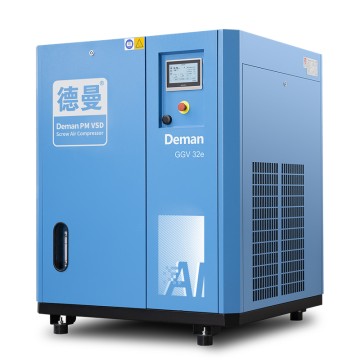
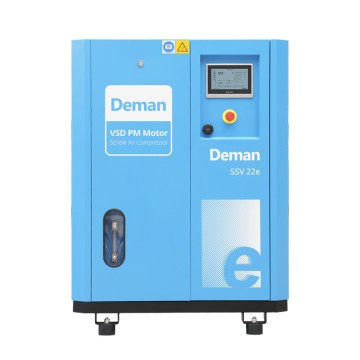
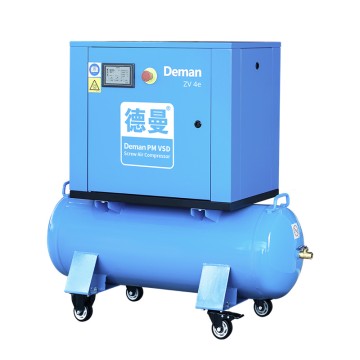
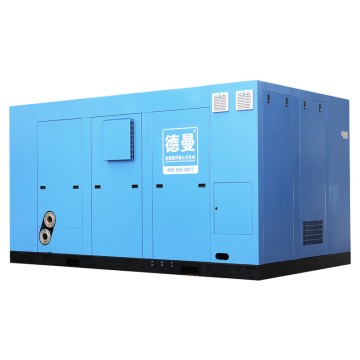
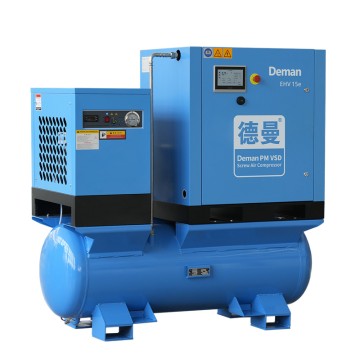
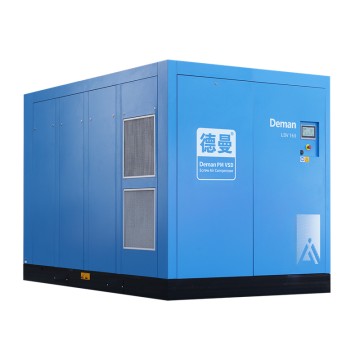
Explore Deman's flagship two-stage and AI-powered air compressor series — precision-engineered to deliver stable, high-pressure compressed air for every pneumatic tool demand.
A two-stage compression air compressor operates by compressing air in two sequential stages rather than a single pass. In the first stage, ambient air is drawn in and compressed to an intermediate pressure level. The partially compressed air is then cooled through an intercooler before entering the second compression stage, where it is further compressed to the desired final pressure.
This intercooling process between stages is the key differentiator. By reducing the temperature of the air before the second compression stage, the compressor achieves significantly higher thermodynamic efficiency. The work required to compress cooled, denser air is considerably less than compressing hot air — resulting in energy savings of up to 15–20% compared to equivalent single-stage machines.
For pneumatic tool applications that require sustained high-pressure output — typically ranging from 10 bar to 40 bar — two-stage compressors are the preferred industrial standard. They deliver more consistent pressure, lower operating temperatures, and longer service life under continuous-duty cycles.
Pneumatic tools — including impact wrenches, air drills, grinders, spray guns, sandblasters, and riveting hammers — demand a reliable, high-volume supply of compressed air at stable pressure. Any pressure fluctuation directly impacts tool performance, production quality, and operator safety.
Two-stage compressors address these demands through superior volumetric efficiency. Because compression occurs across two stages with intermediate cooling, the air charge entering each cylinder is denser and cooler, enabling more air mass to be processed per cycle. This translates to higher free air delivery (FAD) ratings and more consistent downstream pressure at the tool head.
Additionally, the reduced thermal load in two-stage systems means less heat is transferred to the compressed air — resulting in drier output air, reduced moisture contamination, and less wear on pneumatic tool internals. For manufacturing environments where tool longevity and output quality matter, this is a critical operational advantage.
The global industrial air compressor market is undergoing a significant transformation driven by the convergence of energy efficiency mandates, Industry 4.0 digitalization, and the rapid expansion of advanced manufacturing sectors. Two-stage compression technology sits at the heart of this evolution, increasingly displacing older single-stage systems across automotive, aerospace, electronics, and heavy engineering industries.
In China alone — the world's largest manufacturing economy — energy efficiency regulations introduced under the "Made in China 2025" and subsequent carbon neutrality initiatives have accelerated the adoption of variable speed drive (VSD) two-stage compressors. Manufacturers are under regulatory and economic pressure to reduce compressed air system energy consumption, which typically accounts for 20–30% of total factory electricity usage.
Globally, the market for two-stage screw and piston compressors for industrial pneumatic applications is growing at a compound annual growth rate (CAGR) of approximately 5.8%, with Asia-Pacific representing the fastest-growing regional segment. The proliferation of automated assembly lines, robotic manufacturing cells, and precision machining operations — all of which rely heavily on pneumatic actuation — continues to drive sustained demand growth.
From a commercial perspective, the business case for upgrading to two-stage compression systems for pneumatic tool powering has never been stronger. Energy costs represent the dominant lifecycle expense for industrial compressors — often exceeding the initial capital cost within 2–3 years of operation. Two-stage systems with integrated VSD technology can reduce energy bills by 30–40% in variable-load pneumatic tool environments, delivering payback periods as short as 18 months.
Insurance and compliance costs are also driving adoption. Modern two-stage compressors with integrated monitoring systems provide real-time data logging, predictive maintenance alerts, and automated fault detection — reducing unplanned downtime, lowering maintenance costs, and supporting ISO 9001 and ISO 50001 compliance documentation requirements.
For OEM equipment manufacturers and system integrators, the shift toward "compressed air as a service" (CAaaS) business models is creating new commercial opportunities. Two-stage compressors with IoT connectivity and remote monitoring capabilities are the enabling technology for these subscription-based service models, where customers pay per cubic meter of compressed air delivered rather than purchasing capital equipment outright.
Two-stage compression with intercooling reduces the thermodynamic work input required, delivering energy savings of 15–20% over single-stage systems. When combined with PM VSD motor technology, total system efficiency gains can reach 35–40%.
Consistent downstream pressure is critical for pneumatic tool performance. Two-stage systems maintain tighter pressure bands (±0.1 bar) even under rapidly varying tool demand loads, ensuring consistent torque output from impact tools and precise control in pneumatic actuators.
Intercooling between compression stages reduces discharge air temperature by up to 30°C compared to single-stage equivalents. Cooler compressed air contains less moisture, reduces oil carryover, and minimizes thermal stress on downstream pneumatic components.
Lower operating temperatures and reduced pressure differentials per stage significantly decrease mechanical wear on compression elements, bearings, and seals. Two-stage compressors in industrial pneumatic service typically achieve 50,000+ hours of operation between major overhauls.
Next-generation two-stage compressors integrate AI-driven adaptive control systems that analyze real-time demand patterns, predict load cycles, and automatically optimize compression ratios and motor speeds. This eliminates manual tuning and ensures peak efficiency across all operating conditions.
Modern two-stage systems feature embedded IoT sensors monitoring temperature, pressure, vibration, and energy consumption across all critical components. Cloud-connected dashboards provide plant managers with real-time visibility and predictive maintenance alerts, reducing unplanned downtime by up to 60%.
Two-stage compression technology powers the most demanding pneumatic tool environments across multiple industries — from precision electronics assembly to heavy-duty automotive manufacturing.
High-volume automotive assembly lines rely on two-stage compressors to power torque-critical pneumatic impact wrenches, robotic paint spray systems, tire inflation equipment, and body panel assembly tools. Stable high-pressure air ensures consistent bolt torque values and uniform paint film thickness across thousands of daily production cycles.
Aerospace manufacturing demands the highest standards of compressed air purity and pressure stability. Two-stage compressors power precision drilling and riveting tools used in airframe assembly, requiring ±0.05 bar pressure accuracy. Oil-free two-stage variants are mandatory for composite material processing and avionics assembly areas.
Heavy construction sites deploy two-stage compressors to power jackhammers, concrete breakers, rock drills, and sandblasting equipment. The high volumetric flow rates and sustained pressure output of two-stage systems are essential for maintaining tool performance during extended continuous-duty construction operations.
CNC machining centers, grinding operations, and metal fabrication facilities use two-stage compressed air systems to power pneumatic clamping fixtures, air-actuated tool changers, chip evacuation systems, and precision measurement instruments. High-pressure two-stage output enables faster pneumatic cylinder actuation cycles and tighter positional accuracy.
Pharmaceutical and food-grade manufacturing requires ultra-clean compressed air for pneumatic packaging machinery, tablet press tooling, and sterile filling equipment. Oil-free two-stage compressors with integrated drying systems provide ISO 8573-1 Class 1 air quality, meeting FDA and GMP compliance requirements for direct product contact applications.
Semiconductor fabrication and PCB assembly operations use two-stage compressed air for pneumatic pick-and-place systems, precision dispensing equipment, and cleanroom air knife applications. The lower moisture content and reduced oil contamination of two-stage output air is critical for protecting sensitive electronic components from corrosion and contamination.
As global manufacturing industries commit to carbon neutrality targets, two-stage compression technology is evolving to meet stringent energy efficiency standards. The integration of heat recovery systems — capturing waste heat from the intercooler and aftercooler — allows factories to repurpose up to 80% of compression heat energy for space heating, process water heating, or absorption cooling. This dramatically improves overall system energy utilization and reduces carbon footprint.
The next generation of two-stage compressors will be defined by deep AI integration. Machine learning algorithms trained on millions of operating data points will enable compressors to self-optimize compression ratios, predict component failures weeks in advance, and automatically adapt to changing production schedules. This AI-first approach will transform compressors from passive infrastructure into intelligent, responsive production assets.
Two-stage compressors are becoming integral nodes in smart factory ecosystems. OPC-UA and MQTT protocol support enables seamless integration with MES, ERP, and SCADA systems — allowing compressed air production to be automatically orchestrated in response to real-time production schedules. This eliminates manual demand management and ensures compressed air is produced precisely when and where it is needed.
The demand for oil-free two-stage compression is growing rapidly, driven by expanding food, pharmaceutical, electronics, and hydrogen production applications. Advanced PTFE-coated and water-injected two-stage compression technologies are achieving oil-free Class 0 air quality without the performance penalties previously associated with oil-free designs — enabling two-stage efficiency in the most contamination-sensitive environments.
After electricity, gas, and water — compressed air is recognized as the fourth essential utility in modern manufacturing. Two-stage compression systems are the backbone of this utility infrastructure, powering over 70% of all industrial pneumatic tool operations worldwide. Investing in high-efficiency two-stage technology is not just an equipment decision — it is a strategic energy management commitment that directly impacts production cost, product quality, and environmental sustainability.
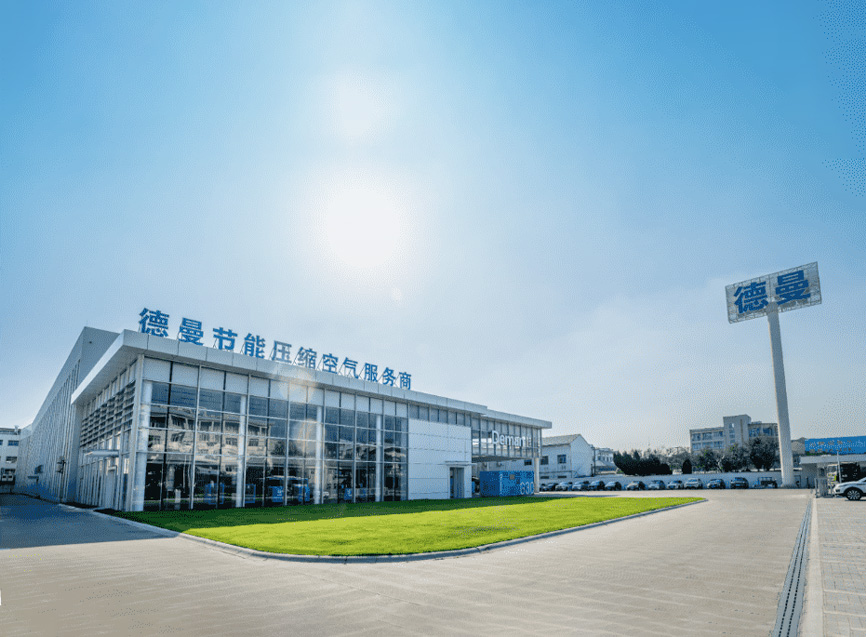
Founded in 1998, Deman has been at the forefront of the air compressor industry by leading the energy-saving initiatives in China. We are the primary drafter of China's industry standards for VSD Oil-injected (JB/T10972) and PM VSD Screw Air Compressors (JB/T 13345-2017).
As a China National High-tech Enterprise, Deman has integrated capabilities in R&D, manufacturing, sales, and service. We have a robust R&D team of over 140 technical professionals. Our factory, based in Ningbo, China is ISO9001:2015, ISO14001:2015, and ISO45001:2018 certified.
Our product testing process strictly adheres to ASME and ISA1932 standards to ensure the delivery of safe and reliable compressors — powering pneumatic tools and compressed air systems across industries worldwide.
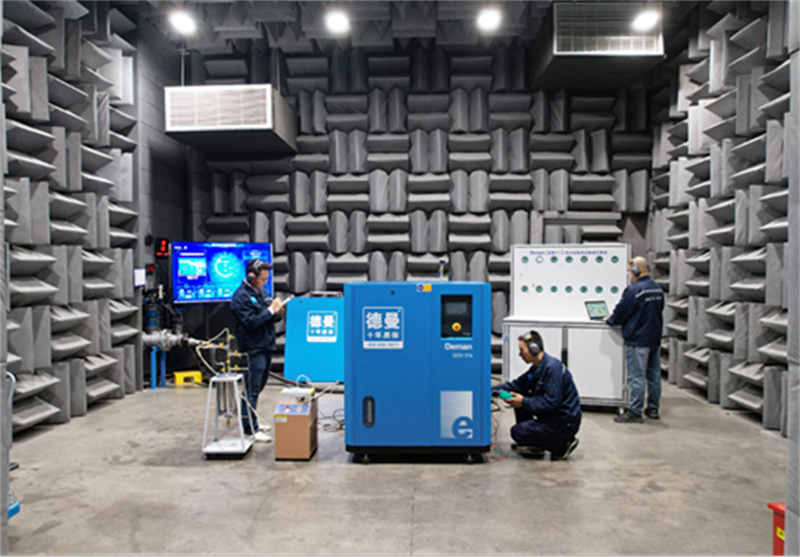
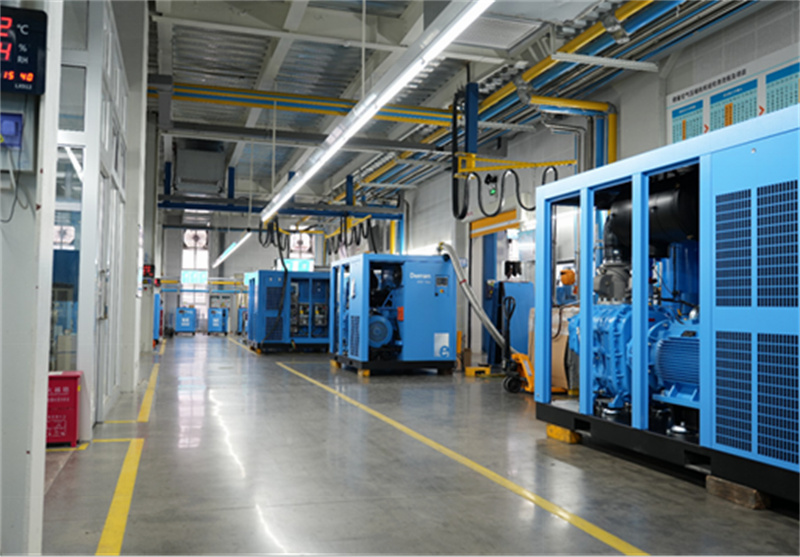
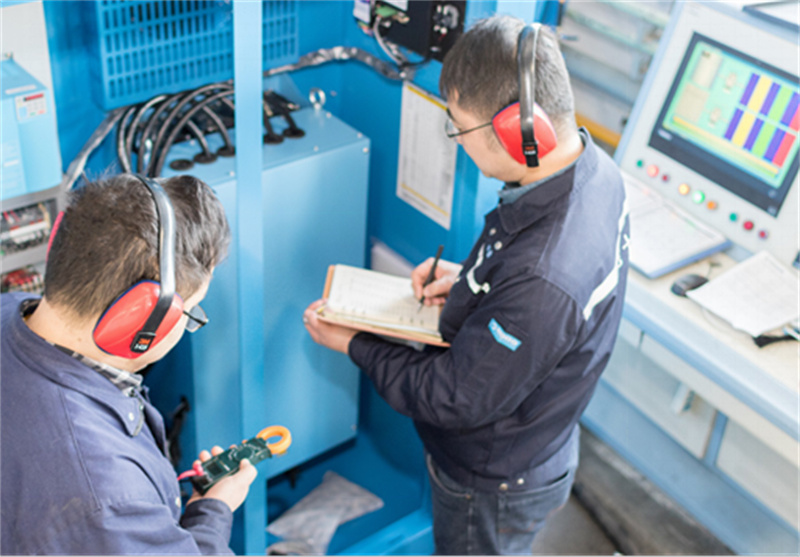
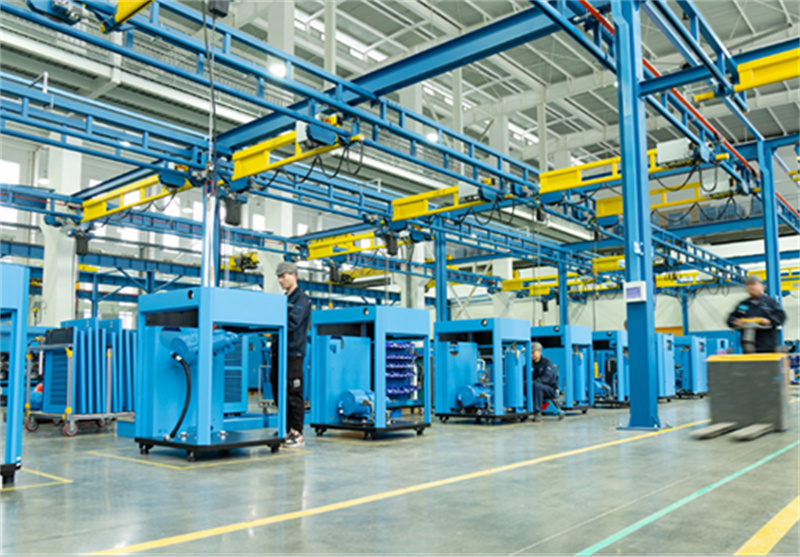
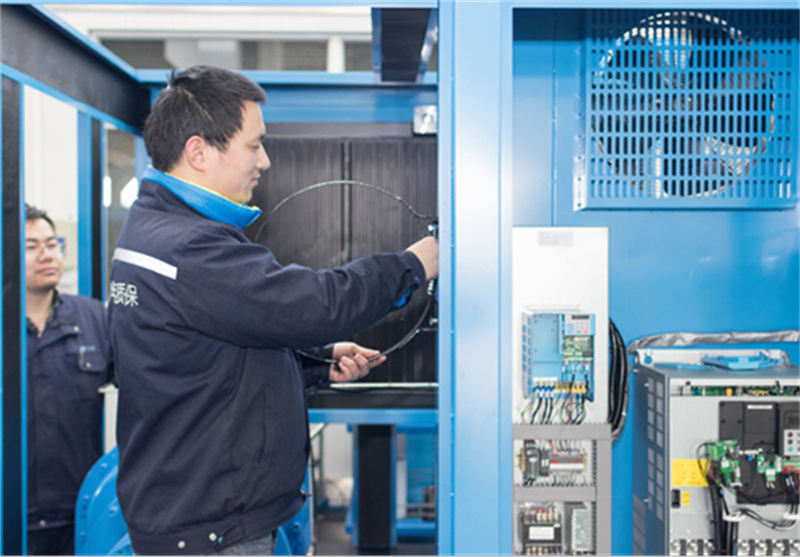
We follow six-end solutions to create infinite value for client's efficient use of compressed air — from initial planning through to ongoing optimization.
"No planning, no machine selling." We make sure to understand the air pressure, air flow, and air quality requirement of each air use terminal at client's factory, before selling anything. When most customers want to spend less for a better machine, we think it is necessary to invest time in planning, to avoid mismatched systems that can reduce production efficiency.
Applying "Three-dimensional Customization" — meaning customize the compressor station in terms of air pressure, air flow, and air quality requirements. By selecting the best combination of Deman air compressors + air dryers + heat recovery unit + "Air Commander" central control system, we make sure customers not only have improved production quality, but also reduced energy consumption.
In order to make customers' life easier, we established a professional team for designing and installing air pipe networks using Deman energy-saving aluminum alloy or stainless-steel green air pipe. Our scientific design, green materials, and professional installation ensures efficient air transmission with minimal pressure drop.
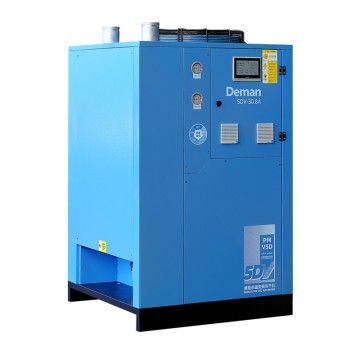
Delivering the right air quality to each pneumatic tool application is critical. Our integrated drying, filtration, and purification solutions ensure that compressed air meets the exact ISO 8573-1 purity class required — preventing tool corrosion, contamination, and premature wear across all downstream pneumatic equipment.
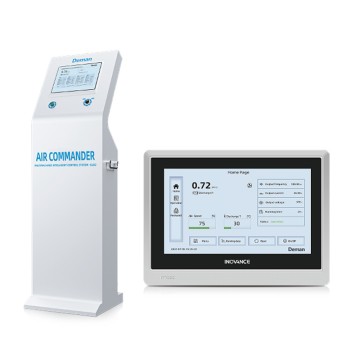
Our "Air Commander" multi-compressor central control system provides real-time energy monitoring, demand forecasting, and automatic load balancing across multiple compressor units. Continuous data analysis identifies inefficiencies and recommends optimization strategies — ensuring the lowest possible energy cost per cubic meter of compressed air delivered.
Deman's global service network ensures rapid response to maintenance requirements, spare parts availability, and technical support. Our remote monitoring capabilities enable proactive service interventions before failures occur — maximizing compressor uptime and protecting the productivity of pneumatic tool operations.
From AI-powered screw compressors to magnetic levitation centrifugal systems — Deman offers a complete portfolio of compressed air solutions engineered for every pneumatic tool application and industry requirement.